
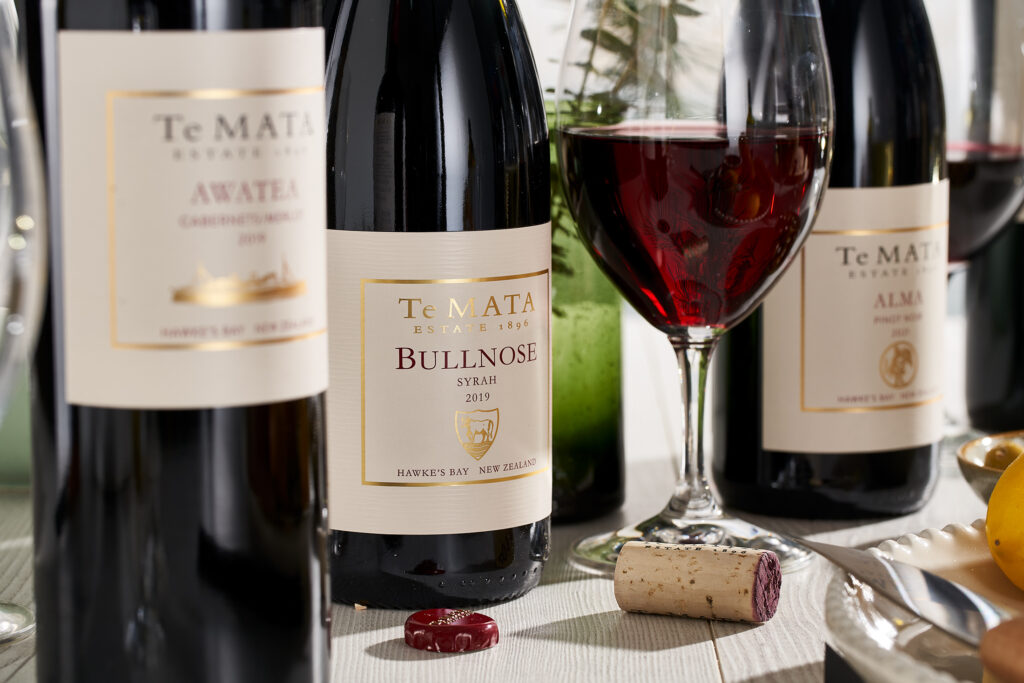
2023 Te Mata Estate Bullnose Syrah – RP 94
The 2023 Bullnose Syrah leads with crushed rocks and rose petals, pomegranate pearls, raspberry and a shading of tapenade. In the mouth, the wine is silky and medium-bodied, more leafy than in previous vintages but leaning toward dried herbs rather than anything indicating “greenness.” A casing of dark chocolate or powdered cocoa is like a gossamer sheath over the fruit and is very attractive. As ever, this is an impressive wine from this Cabernet-focused house in Hawke’s Bay. As usual, the tannins are chalky and supple through the middle palate, and they serve to define the finish
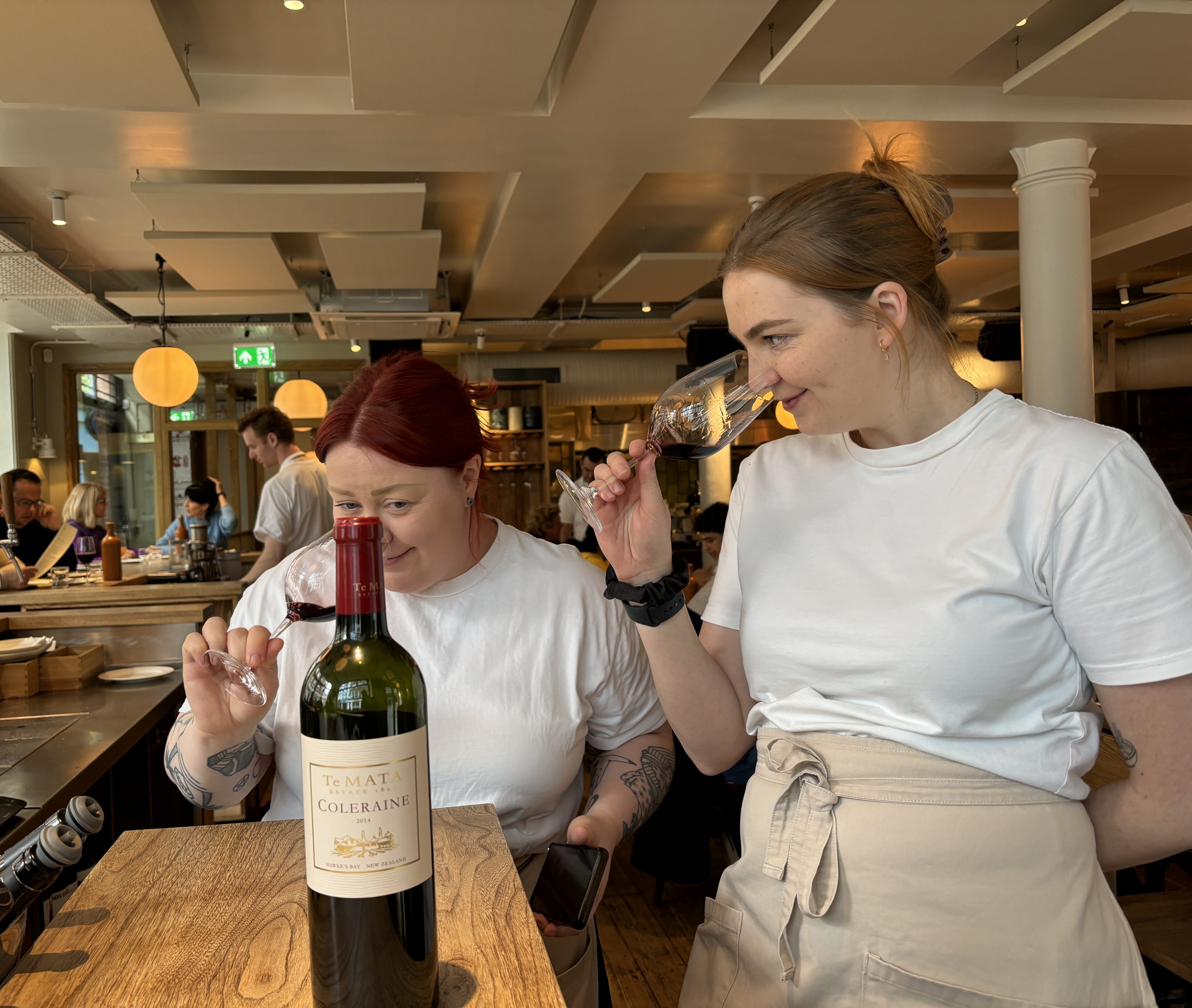
2022 Te Mata Estate Coleraine – RP 97+
The 2022 Coleraine is a blend of 84% Cabernet Sauvignon, 13% Merlot and 3% Cabernet Franc. On the nose, the wine shows its sweet creamy oak, a cavalcade of dark fruit and an array of spices. The wine is powdery and ultra fine, with a gravelly score of tannin woven through the finish. A spectacular wine, it’s still looking so primary and young at this early stage. I note the total acidity is akin to the 2013 vintage, and it serves to add an extra layer of freshness to the finish—a little uptick to close, if you will. This is awesome. It gets better every time I taste it.
2021 Te Mata Estate Coleraine – RP 98
The 2021 Coleraine is the third in a trio of great vintages and comprises a blend of 56% Cabernet Sauvignon, 32% Merlot and 12% Cabernet Franc. The bouquet is all bramble and spice, with fresh grated nutmeg, a hint of star anise, raw cocoa, raspberry seed, cassis, new leather and iodine. There is also a crushed oyster shell aspect here that I find most appealing. On the palate, the tannins make their presence felt in a register of tactile chewiness and encourage movement and thought. Ultimately, while I find this vintage to be stylistically aligned with 2020, it is very different in its final impact. It feels to me as if 2021 harnesses the structure and intrigue of 2019 with the creamy lushness of 2020 and puts them together in a burst of balance. This wine is like a star coming into existence—there’s a bang, a burst of light and a settling period—and it’s astoundingly good.
2020 Te Mata Estate Coleraine – RP 97
If the 2019 Coleraine got you going, then the 2020 will do just the same, albeit at a different speed. Where the 2019 is evolving into a spicy, elegant, medium-bodied affair, the 2020 Coleraine is all silk, creamy finesse and power. It offers abundant fruit, the oak framing is creamy and soft and the tannins are ductile and firm, fully ensconced in the fruit—embossed into it, even. The wine is chewy with pouch tobacco, graphite, raspberry seed, saffron, raw cocoa and nori sheets. It makes me say, “Yes, yes and yes again.” The choice between 2019 and 2020 is purely going to be based on your mood: 2020 will soothe, while 2019 will stoke.
2019 Te Mata Estate Coleraine – RP 97+
The 2019 Coleraine offers a kaleidoscopic spectrum of complexity here, with sweet tobacco, graphite, nori, iodine, fresh blood, pomegranate molasses, layers of cassis, dark chocolate, raspberry seed and sweet roasted beetroot. This is the wine at its most complete; there is everything from leaf, earth, fruit and spice. An array of characters that harness an equal array of emotions is ultimately a wine I want to drink and enjoy. Without a doubt, this is New Zealand’s greatest Cabernet blend, and it more than holds its own on a global stage. It’s super and comes warmly recommended.
2018 Te Mata Estate Coleraine – RP 97+
The 2018 Coleraine is supple and silky. A cavalcade of red and brown notes tumbles forth across the palate, with pomegranate molasses, nutmeg, layers of cassis, bramble, mahogany and raspberry seed. The wine is incredibly fresh, and it’s starting to offer notes of attractive development, albeit at a very slow pace. This 2018 today is the window into both youth and evolution; we can see where it started, in its fete of vibrant youth and energy, but we can also see where it is going, and both views offer pleasure.
2013 Te Mata Estate Coleraine – RP 97
The 2013 Coleraine comprises 56% Cabernet Sauvignon, 30% Merlot and 14% Cabernet Franc. Aromatically, the wine offers saturated purple berries with cassis, licorice/aniseed, raspberry seeds and dark chocolate. On the palate, it exhibits all the chalkiness that defines its success, making it feel both pliable and ductile in its texture, akin to the texture of raw cocoa (fine, powdery, chalky a little grippy/gravelly). It’s excellent. Lovely fresh acidity through the finish lifts it into the register of graphite/lead pencil.
2007 Te Mata Estate Coleraine – RP 95
The 2007 Coleraine is silky and chalky on the palate, with redcurrants, pink peppercorns, a sway of hung deli meat and raw cocoa and layers of graphite and cooling minerals. It is distinctly savory, light and fine. The wine’s defining and most attractive feature is its tannic structure, neatly tucked into the oak, which at this point, and at all points of its evolution, feels seamlessly supportive. It doesn’t have some of the complexity of the younger vintages, yet it remains a beautiful wine. The blend is 52% Cabernet Sauvignon, 34% Merlot and 14% Cabernet Franc.
1992 Te Mata Estate Bullnose Syrah – RP 94
The 1992 Bullnose Syrah was Winemaker Phil Brodie’s first vintage at Te Mata, and the wine is all cocoa, dark chocolate, hung deli meat, clove, star anise and nutmeg. It has evolved into an older wine today; however, the palate remains silky and fine, tempered by cracked autumn leaves, pomegranate molasses, tapenade, lotus leaf, sweet tobacco and crushed gravels. Chalky tannins have been all but decimated by time and are now fully embossed into the fruit. It has blood orange and sweet, smoky marrow through the finish.
1991 Te Mata Estate Coleraine – RP 95
The 1991 Coleraine is now 34 years from its harvest, and the wine coincides with Winemaker Phil Brodie’s arrival at Te Mata. While he had no part in the picking and assemblage, he was here to play a part in its final composition and bottling. While the 1982 featured a portion of American oak—owing mainly to the fact that French oak was, at that time, in short supply—this 1991 is 100% French. On the nose, the wine gives us dried rose petal, summer rain/petrichor, pressed sandalwood, cocoa, autumn leaves and pomegranate molasses. The wine today exhibits all the same tannic structure and texture of the current-day Coleraines, further emphasizing to me this wine’s greatness, its aptitude for graceful aging and my confidence in it as a true fine wine of the world. The bottle I tasted was opened five hours ago, and it remains in condition all this time later. It has not fallen over, and the wine will have many years left in it, I am sure. This is another great Coleraine experience.