


The Hawke’s Bay Difference
New Zealand Sauvignon Blanc is famous around the world, but there is far more than one expression of the variety.
Marlborough remains the country’s great Sauvignon Blanc heartland, while Hawke’s Bay offers a markedly different interpretation. Here, warmer days, cool nights, strong sunlight and a long maritime growing season create wines with a distinctive combination of ripe fruit, perfume, texture and freshness. The result is Sauvignon Blanc that can be intensely flavoured yet bone dry, with juicy acidity and a generosity of palate that sets it apart.
A different climate for Sauvignon Blanc
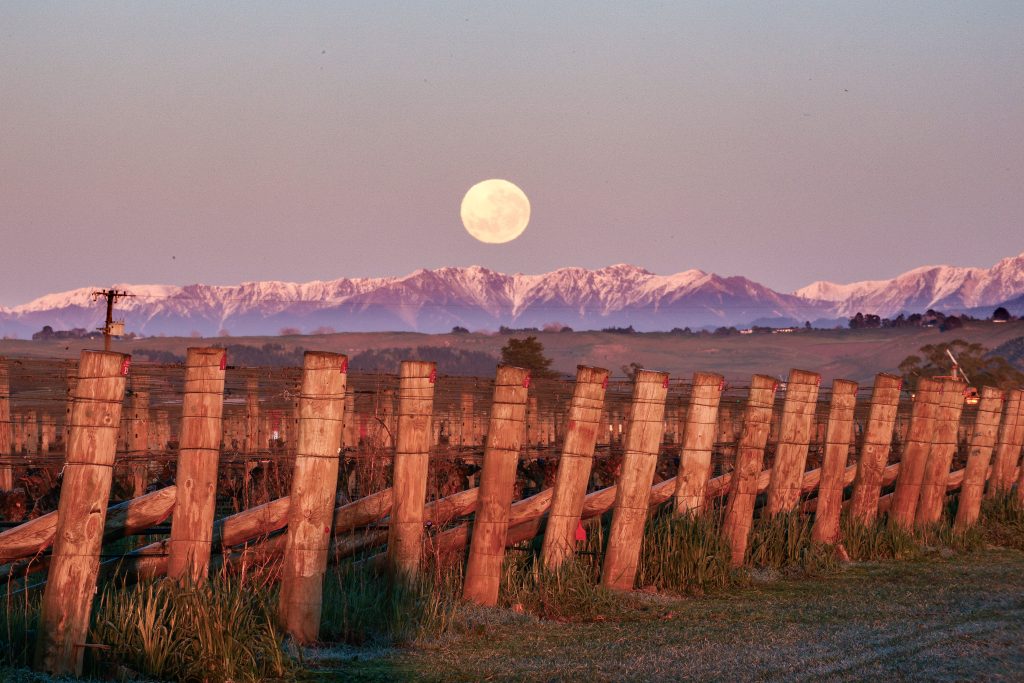
The starting point is climate. Hawke’s Bay sits on the east coast of New Zealand’s North Island, where the Pacific Ocean moderates temperatures and the region’s relatively dry, sunny conditions allow grapes to ripen over a long growing season. Compared with the cooler South Island, Hawke’s Bay gives Sauvignon Blanc more time to develop full flavour maturity before harvest.
That distinction matters because Sauvignon Blanc is unusually responsive to its growing environment. New Zealand research has shown that the aromatic profile of the variety is shaped by vineyard conditions as well as by winemaking. In a study of New Zealand Sauvignon Blanc, researchers found that sunlight exposure altered the balance of important aroma compounds: naturally exposed fruit was riper, with lower levels of methoxypyrazines, the compounds associated with green capsicum and vegetal aromas.
Hawke’s Bay therefore occupies an interesting position within New Zealand. It has the maritime influence and cool nights necessary to preserve freshness, but warmer days and a longer ripening season encourage a different expression of Sauvignon Blanc. The wines can develop intense tropical and stone-fruit flavours without losing the floral and herbal lift that makes the variety so distinctive.
Sunlight, ripeness and perfume
New Zealand’s position in the Southern Hemisphere also brings exceptionally strong ultraviolet radiation during the growing season. UV exposure is only one part of the viticultural equation, but it is a significant environmental characteristic of New Zealand vineyards. The important point is not that UV somehow creates a particular flavour in isolation, but that Hawke’s Bay combines strong sunlight with warmth, cool nights and a long period of ripening.
That combination encourages Sauvignon Blanc to move beyond the sharper green spectrum of very cool-climate examples. Passionfruit, lychee, guava, ripe citrus, white peach, yellow currant and other tropical and orchard-fruit characters can sit alongside grass, coriander, dill and fresh herbs. The herbal character is still unmistakably Sauvignon Blanc, but it can feel more aromatic and savoury than aggressively vegetal.
There is growing scientific evidence that New Zealand Sauvignon Blanc is not a single chemically uniform style. A 2025 study published in Food Chemistry examined 50 commercially produced Sauvignon Blancs from Hawke’s Bay, Marlborough, Wairarapa and North Canterbury. It found significant differences between regions in the concentrations of several volatile sulfur compounds, providing further evidence that regional expression exists at the level of wine chemistry as well as sensory description.
The character of Hawke’s Bay acidity
Perhaps the most interesting distinction is the way acidity behaves in the finished wine. In the coolest parts of New Zealand, particularly in Marlborough, Sauvignon Blanc can retain exceptionally high natural acidity. This gives the wines their characteristic energy and tension, but can also produce a more linear, sharply refreshing style.
Hawke’s Bay offers another possibility. With greater flavour ripeness, the acidity can feel less like a hard line and more like a current running through the wine. It is juicy, persistent and mouthwatering, particularly towards the back of the palate. The cool nights are important here: they help preserve freshness while the warm days continue to develop flavour.
This distinction is perceptible in blind tasting. Wine Enthusiast’s Christina Pickard described Te Mata’s 2024 Estate Sauvignon Blanc as having “lovely texture” alongside “crisp acidity, flavor concentration and a long finish”. The description is revealing because it puts texture and concentration alongside acidity rather than treating freshness as the opposite of ripeness.
The result is a style that can feel closer in spirit to some European expressions of Sauvignon Blanc, particularly the Loire, while retaining the extraordinary fruit intensity for which New Zealand is known. There is often more mid-palate breadth and a subtle creaminess, but without sacrificing perfume or freshness.
Ripe fruit, completely dry
There is another important consequence of this balance. When Sauvignon Blanc is harvested with sufficient flavour ripeness, it does not need sweetness to compensate for high acidity. A wine can have medium-plus natural acidity, substantial fruit concentration and still finish completely dry.
This is particularly significant in the context of New Zealand Sauvignon Blanc. Te Mata Estate’s 2025 Sauvignon Blanc, for example, was described by Wine Enthusiast as “fermented totally dry”, with the reviewer contrasting it with the small amount of residual sugar found in many Marlborough Sauvignon Blancs. Pickard described the wine as “ripe yet fresh”, with lemony acidity and subtle textural weight.
That bone-dry finish gives the wine a particular kind of precision. The palate begins generously, carries intense fruit and perfume through the middle, then tightens into a clean, dry finish. It is this final crispness that prevents ripe Hawke’s Bay Sauvignon Blanc from becoming broad or heavy.
Te Mata Estate Sauvignon Blanc
Te Mata Estate’s Sauvignon Blanc is an expression of this particular Hawke’s Bay balance. The wine is fermented in stainless steel to preserve fruit purity and aromatic character, allowing the vineyard rather than oak to define the style. Its fruit profile can range from passionfruit, guava and citrus through to white peach, green herbs and floral notes.
The style has been recognised repeatedly by international critics. Wine Enthusiast awarded the 2025 Estate Sauvignon Blanc 93 points, describing it as “distinctive” and “lucid”, with ripe tropical-citrus-stone fruit that nevertheless remained fresh. Sam Kim of Wine Orbit similarly described the 2025 wine as “fabulously aromatic”, with nectarine, fresh herbs, lemongrass and lime zest, followed by “excellent vibrancy, fine texture, and bright acidity”.
These descriptions point towards something more interesting than simply calling the wine a “Hawke’s Bay Sauvignon Blanc”. They describe a style in which ripeness and freshness are not competing qualities. The fruit is ripe because of Hawke’s Bay’s growing conditions, while the acidity and perfume are preserved by the region’s maritime influence and cool nights.
Cape Crest and the Bordeaux connection
Cape Crest takes this idea considerably further. Te Mata has been making the wine since 1982, using Sauvignon Blanc with small proportions of Sémillon and Sauvignon Gris. The wine is barrel fermented and aged on its lees, giving it a different texture and architecture from a purely stainless-steel Sauvignon Blanc.
Sémillon contributes longevity, while Sauvignon Gris contributes weight and mouthfeel. Lees ageing and batonnage build further texture, while the use of French oak adds complexity without obscuring the variety’s fruit and acidity. The result is a wine with the concentration and aromatic intensity of Hawke’s Bay Sauvignon Blanc, but with the structural ambition of a fine white Bordeaux.
Wine Enthusiast’s description of the 2024 Cape Crest is telling. It called the wine capable of “giving white Bordeaux a run for its money”, noting its honeyed richness, creamy texture and “vivid acidity and pithy, lip-smacking refreshment”.
Decanter made the comparison even more explicit when tasting the 2018 vintage. James Button observed that, although the wine was recognisably New Zealand Sauvignon Blanc, it was “the intensity that stands it apart”, placing it in a tasting alongside Loire Sauvignon.
Sauvignon Blanc with the capacity to age
This is where Cape Crest moves beyond the conventional idea of New Zealand Sauvignon Blanc as a wine intended to be consumed young. The combination of ripe fruit, acidity, oak, lees texture and Sémillon gives the wine the structural components necessary for development in bottle.
With age, the exuberant tropical fruit begins to evolve towards grapefruit, beeswax, citrus, floral and savoury characters. The texture becomes more integrated and the wine’s underlying acidity increasingly apparent. It is still recognisably Sauvignon Blanc, but its expression becomes quieter, more complex and more reminiscent of the great dry white wines of Bordeaux.
Richard Hemming MW made the comparison directly in his 2022 review of Cape Crest, writing that it “aligns with the Bordeaux model of dry, oak-influenced, ageworthy Sauvignon Blanc” and bears comparison with the whites of Pessac-Léognan and Graves.
That is a useful way to understand Cape Crest. It is not an attempt to make Bordeaux in Hawke’s Bay. Rather, it explores what Hawke’s Bay Sauvignon Blanc can become when its natural concentration, perfume and acidity are given more texture, time and structure.
The Hawke’s Bay difference
Hawke’s Bay does not need to compete with Marlborough by making a warmer version of Marlborough Sauvignon Blanc. Its opportunity is more interesting than that. The region’s combination of strong sunlight, warm days, cool nights, maritime influence and long ripening season allows Sauvignon Blanc to occupy a broader stylistic space: ripe but fresh, aromatic but textured, intensely flavoured but bone dry.
That is the Hawke’s Bay difference. The wines retain the perfume, energy and vivid fruit intensity that made New Zealand Sauvignon Blanc famous, but can add another dimension of ripeness, texture and palate length. In Te Mata Estate Sauvignon Blanc, that balance is expressed through fruit purity, juicy acidity and a dry finish. In Cape Crest, it is pushed further towards the structural complexity and longevity of fine white Bordeaux.
Sauvignon Blanc may have made New Zealand famous, but Hawke’s Bay shows how far the variety can travel within the country itself. Here, the combination of sunlight and cool nights, warmth and maritime freshness, fruit intensity and dryness creates a style that is unmistakably New Zealand while being distinctly, and recognisably, Hawke’s Bay.