

Chardonnay and Pinot Noir at Te Mata Estate: A Burgundy Tradition in Hawke’s Bay
From the first Chardonnay and Pinot Noir vines planted in 1892 to Elston and Alma today, Te Mata Estate has spent more than 130 years exploring how these great Burgundy varieties express the vineyards and climate of Hawke’s Bay.
Chardonnay and Pinot Noir: the beginning of Te Mata Estate
The story of Chardonnay and Pinot Noir at Te Mata Estate begins with the foundation of the winery itself.
In 1892, Bernard Chambers planted Chardonnay and Pinot Noir on three elevated, north-facing parcels in the Havelock Hills above the Te Mata Station homestead.
Chambers was one of New Zealand’s earliest wine pioneers. After travelling through France, California and Australia, he returned to Hawke’s Bay with an unusually sophisticated understanding of viticulture and winemaking for nineteenth-century New Zealand.
He began converting the station’s 1870s stables into a winery and set out to make dry, European-style wines at a time when much of New Zealand’s commercial wine production was focused on sweet and fortified styles.
Chardonnay and Pinot Noir were therefore part of Te Mata’s wine story from the beginning.
Te Mata’s own history records the first commercial wines as being made for sale to the public and export, an unusually ambitious proposition in 1890s New Zealand.
1896: Pinot Noir reaches the New Zealand public
The early Pinot Noir vines were sourced from pioneering New Zealand vineyards, including material associated with the Marist vineyards at Meeanee and early Taradale plantings.
By the 1896 vintage, Te Mata was making wine commercially from its European grape varieties.
This distinction matters.
Te Mata was not simply experimenting with Pinot Noir and Chardonnay in a pioneering vineyard. It was growing these varieties, making dry wines from them and offering those wines commercially to the New Zealand public.
The first official Te Mata vintage was released in 1896, and the quality of the early wines attracted the attention of government viticulturalist Romeo Bragato.
After tasting the young Pinot Noir, Bragato wrote:
“Here I tasted some beautiful wine…”
The Pinot Noir story at Te Mata was therefore commercial and ambitious from the outset.
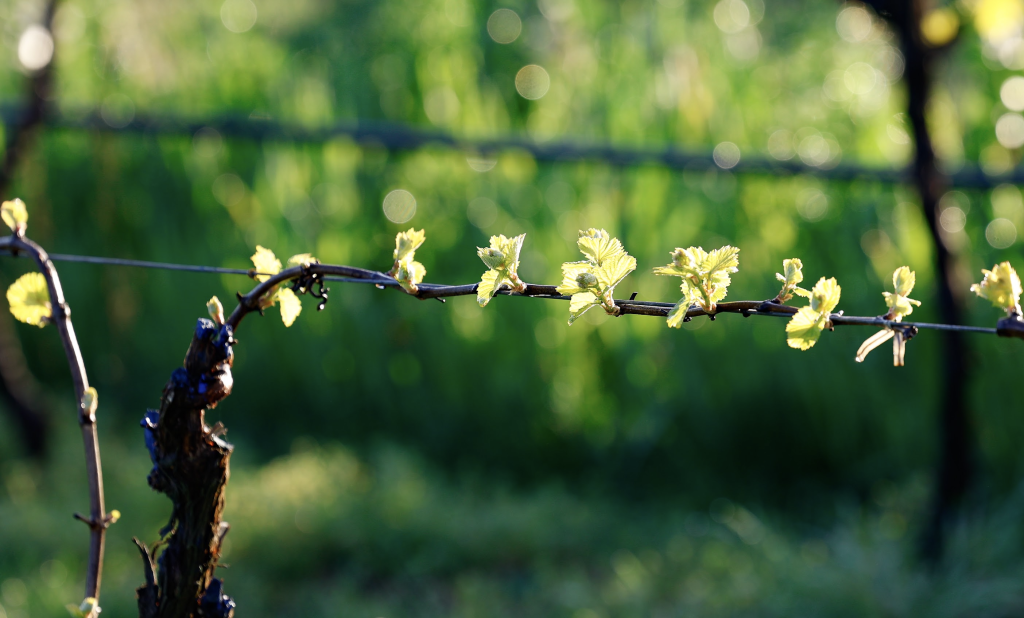
The oldest working connection between vineyard and winery
There is an extraordinary continuity to the Te Mata story.
The original vineyards planted in the 1890s still form part of the modern estate, and Te Mata continues to make wine on the original site and in the historic winery buildings.
Te Mata describes itself as New Zealand’s oldest operating winery, with the original winemaking operation never having been moved from its historic site.
That means the connection between vineyard, winery and wine has survived for more than 130 years.
1892: Chardonnay and Pinot Noir are planted.
1896: The first wines are released commercially.
Today: Te Mata continues to make Chardonnay and Pinot Noir from its Hawke’s Bay vineyards.
Few New Zealand wine estates can tell such a continuous story of place.
Te Mata Chardonnay: 134 years of vineyard history
The historic Chardonnay vineyards in the Havelock Hills are at the heart of this story.
First planted in 1892, they are recognised by Te Mata as New Zealand’s oldest continuously producing Chardonnay vineyard.
The vineyards sit on elevated, north-facing hillsides close to Te Mata Peak, where ancient marine sediments have been uplifted to form a distinctive landscape of limestone, sandstone and clay.
This geological history is particularly significant for Chardonnay.
The soils provide a combination of mineral structure, water-holding capacity and natural restriction, while the elevation and aspect provide excellent exposure to sunlight and cooling maritime influences.
The result is a vineyard environment capable of producing Chardonnay with both concentration and freshness.
Elston Chardonnay: the heart of the historic vineyards
Elston Chardonnay is the most concentrated expression of this historic Chardonnay heritage.
Produced since 1984, Elston takes its fruit primarily from Te Mata’s oldest Chardonnay vineyards in the Havelock Hills.
The vineyards are naturally low yielding, with hand harvesting and individual parcel selection allowing the winemaking team to identify the finest components of each vintage.
The wine is then built from these individual components, with careful French oak maturation contributing texture and complexity.
Elston is now one of New Zealand’s benchmark Chardonnays.
In 2026, James Suckling named Te Mata Elston Chardonnay 2024 the No. 1 Chardonnay in the world for value, as well as No. 4 among all wines in his global value ranking.
Why Hawke’s Bay works so well for Chardonnay
Hawke’s Bay offers an unusual combination of conditions for Chardonnay.
The region receives abundant sunlight and has a long growing season, allowing the grapes to achieve full physiological ripeness.
At the same time, the region’s maritime influence brings cooling breezes and relatively cool nights.
Te Mata’s Havelock Hills vineyards sit only a few kilometres from the Pacific Ocean, and their elevated north-facing position allows the vines to capture sunlight while benefiting from cooling air.
This produces an important balance:
| Hawke’s Bay influence | Effect on Chardonnay |
|---|---|
| Long, sunny growing season | Ripe fruit and concentration |
| Cool nights | Natural acidity and freshness |
| Maritime influence | Aromatic lift and balance |
| Limestone and marine-derived soils | Mineral character and structure |
| Elevated north-facing vineyards | Consistent ripening |
| Low yields | Concentration and intensity |
| Hand harvesting | Precision and fruit quality |
The result is a style that combines New World ripeness with freshness, structure and longevity.
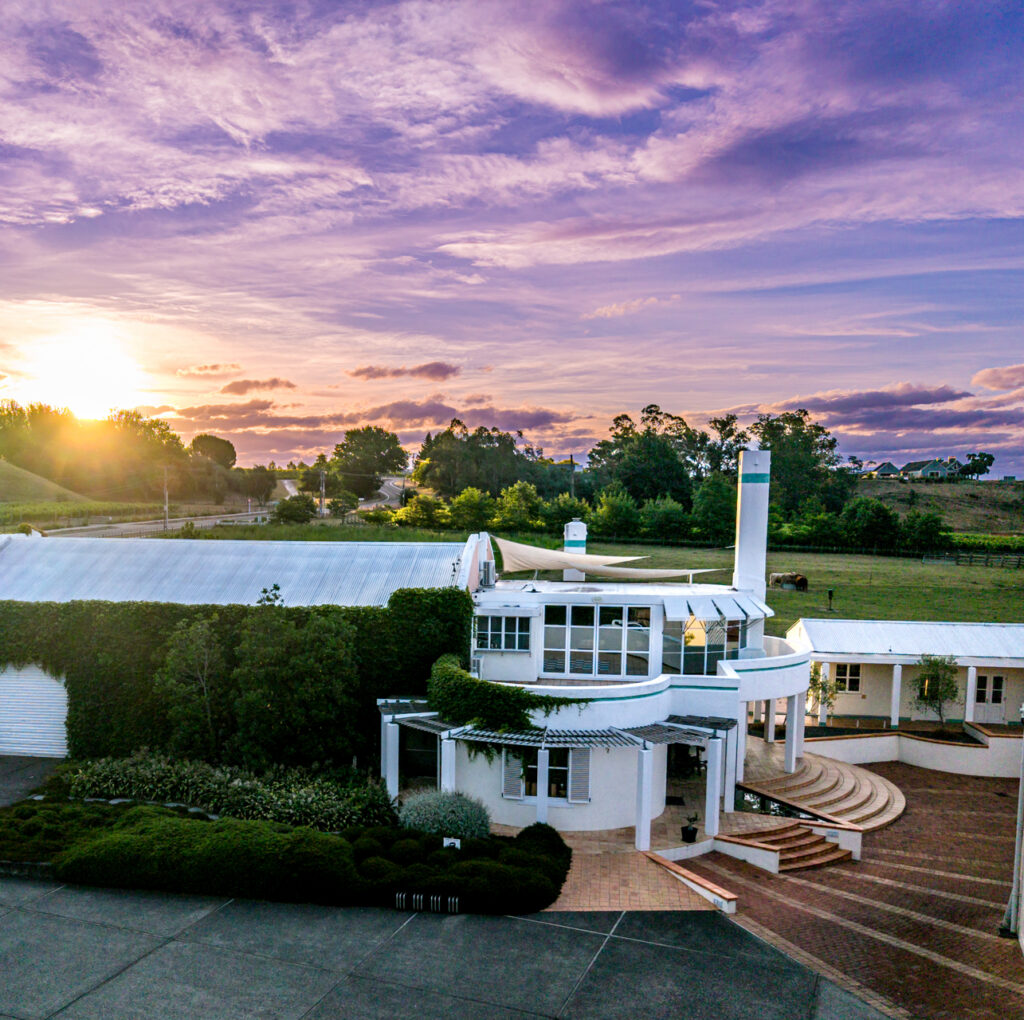
The light of Hawke’s Bay
The intense sunlight of Hawke’s Bay also contributes directly to the character of Te Mata Chardonnay.
The high levels of ultraviolet light encourage Chardonnay grapes to develop thicker skins, contributing phenolic texture and distinctive flavours of citrus peel, grapefruit pith and mineral freshness.
As the wines develop, these characters can become more complex, moving towards:
- White peach
- White-fleshed nectarine
- Grapefruit
- Lemon and lime curd
- Citrus peel
- Flint and mineral notes
- Fine, sherbet-like acidity
This combination of ripe fruit, phenolic texture, mineral character and persistent acidity is a defining feature of Te Mata Chardonnay.
Two Chardonnays, one philosophy
Te Mata Estate makes two principal Chardonnays:
| Wine | Vineyard expression | Style |
|---|---|---|
| Elston Chardonnay | Primarily the historic Havelock Hills Chardonnay vineyards | Concentrated, complex, structured and built for longevity |
| Estate Chardonnay | Selected Te Mata vineyards across Hawke’s Bay | A broader expression of Te Mata’s Chardonnay vineyards and Hawke’s Bay |
Both wines are estate grown and estate bottled.
Both reflect the same underlying philosophy: careful vineyard selection, low cropping, hand harvesting, small-batch winemaking and French oak maturation.
The difference is primarily one of vineyard selection and the particular expression sought in the finished wine.
Pinot Noir: a pioneer variety returns
Pinot Noir has an equally long history at Te Mata, but its modern story took a different path.
Although Pinot Noir was planted by Bernard Chambers in 1892 and produced for Te Mata’s early wines, it eventually disappeared from the estate’s principal commercial range.
In 1999, Te Mata began a twenty-year Pinot Noir research and development project.
The objective was ambitious: to establish whether Hawke’s Bay could produce a Pinot Noir with the depth, structure, finesse and longevity associated with the world’s great examples of the variety.
The project was deliberately long term.
The vineyard was planted, observed and developed for two decades before the first modern releases.
A Burgundy influence, without trying to make Burgundy
The Pinot Noir project was overseen by Te Mata winemaker Philip Brodie, whose experience included working in Burgundy at Domaine F. & L. Saier in Mercurey and at Clos des Lambrays in Morey-Saint-Denis.
That experience provided an important reference point.
But the objective was never to reproduce Burgundy in New Zealand.
Instead, the question was:
What can Pinot Noir become when it is treated with the precision and seriousness of Burgundy, but grown in a particular Hawke’s Bay vineyard?
That distinction remains central to the wines today.
Woodthorpe: the Pinot Noir vineyards
Te Mata’s modern Pinot Noir comes from the Woodthorpe vineyards in the Dartmoor Valley.
The vineyards sit on elevated inland terraces, creating a cooler environment than many of Hawke’s Bay’s warmer sites.
Their inland position and elevation allow the vines to benefit from cool air descending from the central North Island mountain ranges.
This is particularly important for Pinot Noir, a thin-skinned variety that responds well to slower, more measured ripening.
The result is a style of Hawke’s Bay Pinot Noir with ripe fruit, fine tannin, freshness and considerable structural depth.
Two Pinot Noirs
Te Mata now makes two Pinot Noirs:
| Wine | Origin | Character |
|---|---|---|
| Estate Vineyards Pinot Noir | Woodthorpe Vineyards | A structured, elegant expression of Te Mata’s Hawke’s Bay Pinot Noir |
| Alma Pinot Noir | Selected Woodthorpe parcels | The most concentrated and complex expression of the Pinot Noir project |
Individual vineyard parcels are harvested separately and fermented independently.
This allows the winemaking team to work with the differences between blocks, aspects, soils, clones and growing conditions before assembling the final wines.
It is an approach strongly influenced by the Burgundian idea that great wine begins with understanding the individual parts of a vineyard.
Parcel selection: thinking like Burgundy
The Te Mata approach is therefore not simply about choosing Pinot Noir or Chardonnay.
It is about understanding place at increasingly fine levels of detail.
A vineyard is not treated as one uniform piece of land.
Instead, the team considers:
- Vineyard
- Sub-region
- Block
- Aspect
- Terrace
- Soil
- Clone
- Mesoclimate
- Microclimate
- Vintage
Separate parcels can then become individual blending components.
This allows Te Mata to build complexity by understanding the vineyard from the ground up.
It is a distinctly Burgundian way of thinking about place, applied to Hawke’s Bay.
The character of Te Mata Pinot Noir
Te Mata Pinot Noir combines ripe Hawke’s Bay fruit with a distinctly savoury and structured character.
Typical characters include:
- Dark plum
- Black and red cherry
- Wild strawberry
- Tea
- Spice
- Truffle
- Dried herbs
- Savoury and umami notes
- Fine, structured tannins
There are clear points of comparison with Burgundy, but also with the structured, cool-climate Pinot Noirs of Oregon and Washington State.
Ultimately, however, these wines are neither Burgundy nor Oregon.
They are Te Mata Pinot Noir from Hawke’s Bay.
Recent critical recognition, including 95 points for Alma 2024 from James Suckling, reflects the increasing attention being given to Hawke’s Bay Pinot Noir and to Te Mata’s particular expression of the variety.
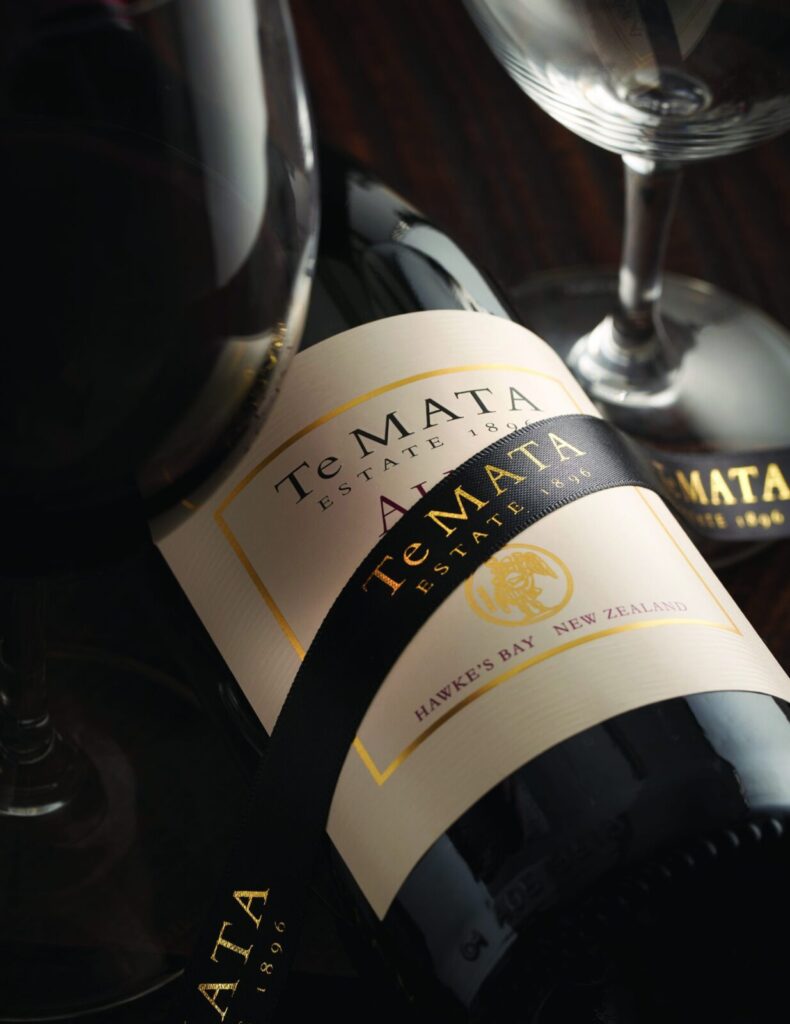
Alma Pinot Noir: a family story
The story of Alma goes beyond viticulture and winemaking.
The wine celebrates Dr James Thomson, a forefather of the Buck family and a hero of the 1854 Battle of the Alma during the Crimean War.
Dr Thomson volunteered to treat wounded enemy soldiers who had contracted cholera. According to Te Mata’s family history, he saved more than 400 lives before ultimately sacrificing his own.
He was awarded a medal for his valour.
That medal appears on the label of Alma Pinot Noir.
Alma therefore connects the modern Pinot Noir project with the history of the Buck family and the broader history of Te Mata Estate.
Old vineyards, new technology
The history of Te Mata Chardonnay and Pinot Noir is not simply a story about heritage.
It is a story about combining heritage with continual innovation.
Historic vineyard sites are farmed using modern viticultural techniques, including:
- Low-cropping vineyard management
- Hand harvesting
- Careful canopy management
- Cover crops
- Detailed vineyard mapping and parcel selection
- Modern sorting technology
- Small-batch fermentation
- French oak maturation
- Continued evaluation of new grape clones
The estate’s long-term Chardonnay redevelopment and Pinot Noir project have also allowed Te Mata to build an increasingly detailed understanding of individual clones and vineyard sites.
The philosophy is simple:
Keep learning from the vineyard.
Burgundy varieties, Hawke’s Bay expression
There is a natural temptation to describe Te Mata Chardonnay and Pinot Noir as “Burgundian”.
The comparison is useful, but it needs to be understood correctly.
Te Mata does not attempt to recreate Burgundy in New Zealand.
Instead, it uses the two great Burgundy varieties as a framework for understanding Hawke’s Bay’s own sense of place.
For Chardonnay, that means:
Ancient marine soils + limestone + clay + elevated north-facing slopes + intense sunlight + cool maritime nights.
For Pinot Noir:
Elevated inland terraces + cooler mountain air + carefully selected clones + slow ripening + precise parcel selection.
The grape varieties may have their origins in Burgundy.
The wines belong to Hawke’s Bay.
From 1892 to today
The history can be summarised simply:
| Year | Milestone |
|---|---|
| 1892 | Bernard Chambers plants Chardonnay and Pinot Noir in the Havelock Hills |
| 1896 | Te Mata’s first official vintage; early European-style wines are released commercially |
| 1890s | Pinot Noir receives praise from government viticulturalist Romeo Bragato |
| 1974 | John Buck and Michael Morris acquire Te Mata Estate and begin its modern restoration |
| 1984 | Elston Chardonnay is established as a Te Mata wine |
| 1992 | The historic Chardonnay vineyards reach their first century |
| 1999 | Te Mata begins its long-term Pinot Noir project at Woodthorpe |
| 2018 | First Alma and Estate Vineyards Pinot Noir wines are harvested |
| 2019 | Alma and Estate Vineyards Pinot Noir are released |
| 2026 | Elston Chardonnay is named James Suckling’s No. 1 Chardonnay in the world for value |
| Today | Te Mata continues to produce Elston and Estate Chardonnay, and Alma and Estate Vineyards Pinot Noir from Hawke’s Bay vineyards |
A 130-year conversation with Burgundy
The most interesting aspect of Te Mata’s relationship with Chardonnay and Pinot Noir is its continuity.
The varieties were planted in 1892.
The first wines were offered commercially in 1896.
The historic Chardonnay vineyards remain in production.
Pinot Noir, after disappearing from the commercial range, was deliberately rediscovered through a twenty-year research project.
And today, Te Mata continues to explore these varieties using the same fundamental principles that have guided the estate for more than a century: site, selection, precision and patience.
The result is not Burgundy transplanted to New Zealand.
It is something more interesting.
Chardonnay and Pinot Noir interpreted through the soils, climate, light and landscapes of Hawke’s Bay.
That is the Te Mata Estate expression of Burgundy’s great varieties.
Te Mata Chardonnay and Pinot Noir at a glance
| Chardonnay | Pinot Noir | |
|---|---|---|
| First planted at Te Mata | 1892 | 1892 |
| Historic site | Havelock Hills | Havelock Hills / Woodthorpe for modern Pinot Noir |
| Modern flagship | Elston Chardonnay | Alma Pinot Noir |
| Other wine | Estate Chardonnay | Estate Vineyards Pinot Noir |
| Key soils | Marine-derived limestone, sandstone and clay | Elevated river terraces |
| Climate influence | Hawke’s Bay sunlight + maritime cooling | Inland elevation + cool mountain air |
| Viticultural approach | Low cropping, hand harvest, parcel selection | Low cropping, hand harvest, parcel selection |
| Winemaking | Small-batch fermentation, French oak | Separate parcel fermentation, French oak |
| Burgundy connection | Chardonnay, limestone, parcel selection, French oak | Pinot Noir, parcel selection, French oak, Burgundy winemaking experience |
| Te Mata expression | Ripe, mineral, textured, fresh and persistent | Structured, savoury, aromatic and age-worthy |
Frequently asked questions
When was Chardonnay first planted at Te Mata Estate?
Chardonnay was first planted at Te Mata Estate in 1892 by Bernard Chambers in the Havelock Hills of Hawke’s Bay.
When was Pinot Noir first planted at Te Mata Estate?
Pinot Noir was also first planted at Te Mata in 1892. Te Mata produced Pinot Noir for its first official vintage in 1896.
What is Te Mata’s oldest Chardonnay vineyard?
Te Mata’s historic Havelock Hills Chardonnay vineyards were first planted in 1892 and are recognised by the estate as New Zealand’s oldest continuously producing Chardonnay vineyard.
What is Elston Chardonnay?
Elston is Te Mata Estate’s flagship Chardonnay, produced since 1984 and sourced primarily from the estate’s historic Havelock Hills Chardonnay vineyards.
Where does Te Mata Pinot Noir come from?
Te Mata’s modern Pinot Noir wines come from the estate’s Woodthorpe vineyards in the Dartmoor Valley in inland Hawke’s Bay.
What are Te Mata’s Pinot Noir wines?
Te Mata makes Alma Pinot Noir and Estate Vineyards Pinot Noir.
What are Te Mata’s Chardonnay wines?
Te Mata makes Elston Chardonnay and Estate Chardonnay.
Is Te Mata Chardonnay made in the style of Burgundy?
Te Mata uses Chardonnay and winemaking principles associated with Burgundy, including parcel selection and French oak, but the wines are intended to express Hawke’s Bay rather than imitate Burgundy.
What makes Hawke’s Bay suitable for Chardonnay?
Hawke’s Bay combines abundant sunlight and a long growing season with cooling maritime influences and cool nights. Te Mata’s elevated Havelock Hills vineyards also contain ancient marine-derived soils including limestone, sandstone and clay.
Why is Pinot Noir suited to Woodthorpe?
The elevated inland Woodthorpe vineyards provide a cooler growing environment than many Hawke’s Bay sites. This helps Pinot Noir ripen gradually while retaining freshness, acidity and structure.
Why is Alma Pinot Noir called Alma?
Alma commemorates the 1854 Battle of the Alma and Dr James Thomson, a forefather of the Te Mata Buck family who treated wounded soldiers during the Crimean War. His medal for valour appears on the Alma label.
Discover Te Mata Estate
Te Mata Estate remains a family-owned, Hawke’s Bay wine estate producing estate-grown and estate-bottled wines from its historic vineyards.
Explore the estate’s Chardonnay, Pinot Noir, Hawke’s Bay vineyards, history and current wines to discover how more than 130 years of winemaking continues to shape Te Mata today.