


For nearly a decade, Te Mata has been quietly applying regenerative viticulture across our Havelock Hills, Bridge Pa, and Dartmoor vineyards. This is not a gesture toward fashion, but a disciplined exploration: watching, testing, and letting each method prove itself in the vineyard and in the glass. From cover crops to mycorrhizal networks, polyculture to low-till practices, each intervention is measured, site-specific, and always in service of the wine. Here, regenerative viticulture is not an experiment for its own sake – it is a lens through which the precision of the vineyard can be realised.
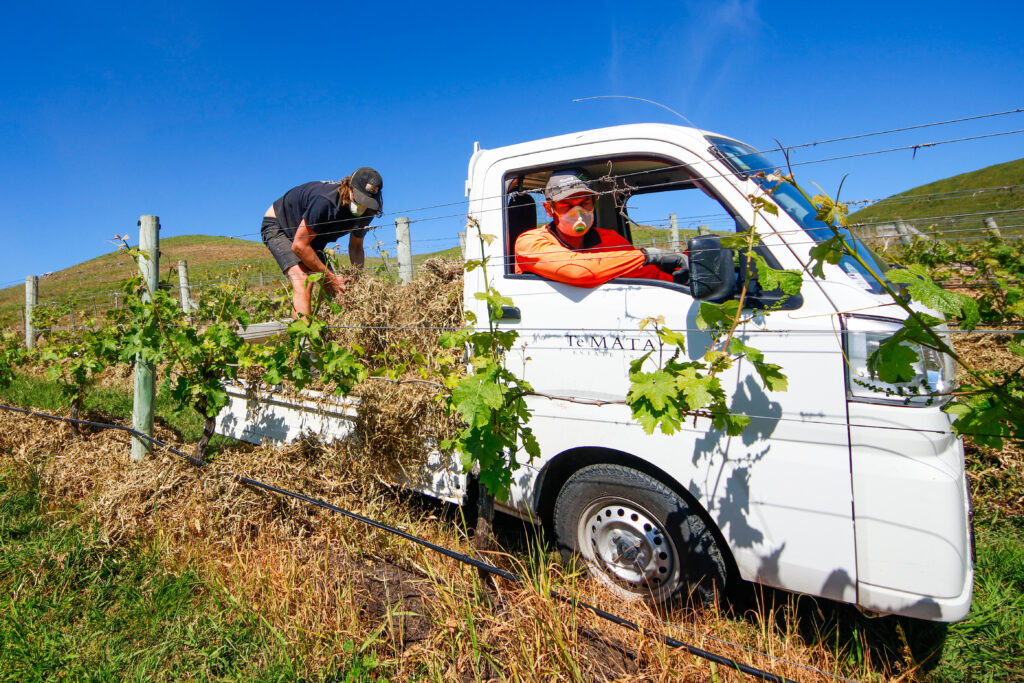
Our regenerative toolkit is broad and detailed. Companion planting, wildflower strips, no-drill tilling, low-till cultivation, and precision seeding machinery are applied where they make the most impact. Legumes and brassicas enrich soil life and feed beneficial insects; clover acts as a natural insectary. These layers of life in the soil increase water retention, enhance carbon sequestration, and allow vines to grow in a more balanced, resilient way. Across all our varietals, these practices are subtle yet cumulative, shaping the vines’ ability to express their site without interference.
Beneath the surface, a quiet complexity is at work. Mycorrhizal fungi and soil microbes form networks that exchange nutrients, signal stress, and improve vine immunity. It is here in this subterranean communication – that much of the vineyard’s character originates. Vines supported by these networks ripen with steadier, more measured growth; their fruit carries texture, tension, and vibrancy that speak of life in the soil rather than manipulation in the winery. The difference is felt in the mid-palate: layered, supple tannins, integrated acidity, and a resonance of flavour that feels intrinsic, not engineered.
Precision viticulture guides this work. Each regenerative practice is mapped, monitored, and assessed; nothing is applied uniformly for effect alone. In Bridge Pa, low-till plots allow soil to sequester carbon while nurturing microbial diversity; in Dartmoor, polyculture helps vines develop subtle aromatic complexity and structure. The result is wines that are layered rather than linear, expressive rather than amplified. They do not shout varietal clichés but instead reveal a quiet, textural depth that rewards patience and attention.

What distinguishes Te Mata is not any single method, but the patient orchestration of many small steps over time. Where regenerative viticulture is now being spoken of as a new frontier, we have been cultivating it for years, integrating slowly, testing empirically, and only adopting what proves resilient in both vineyard and glass. This measured approach allows innovation to enhance rather than overwhelm, guiding each vine to express its site with fidelity and nuance.
The work of regeneration is continuous, and its influence is subtle but tangible in the wines. Soil alive with microbial networks produces grapes that carry energy, tension, and layered aromatics—mid-palates that expand gently, acidity that supports rather than dominates, and tannins that resolve with suppleness. It is a quiet, persistent vitality, one that reminds us that excellence is a process rather than a moment. At Te Mata, regenerative viticulture is not a trend; it is a practice in pursuit of enduring expression. #BetterNeverStops.